


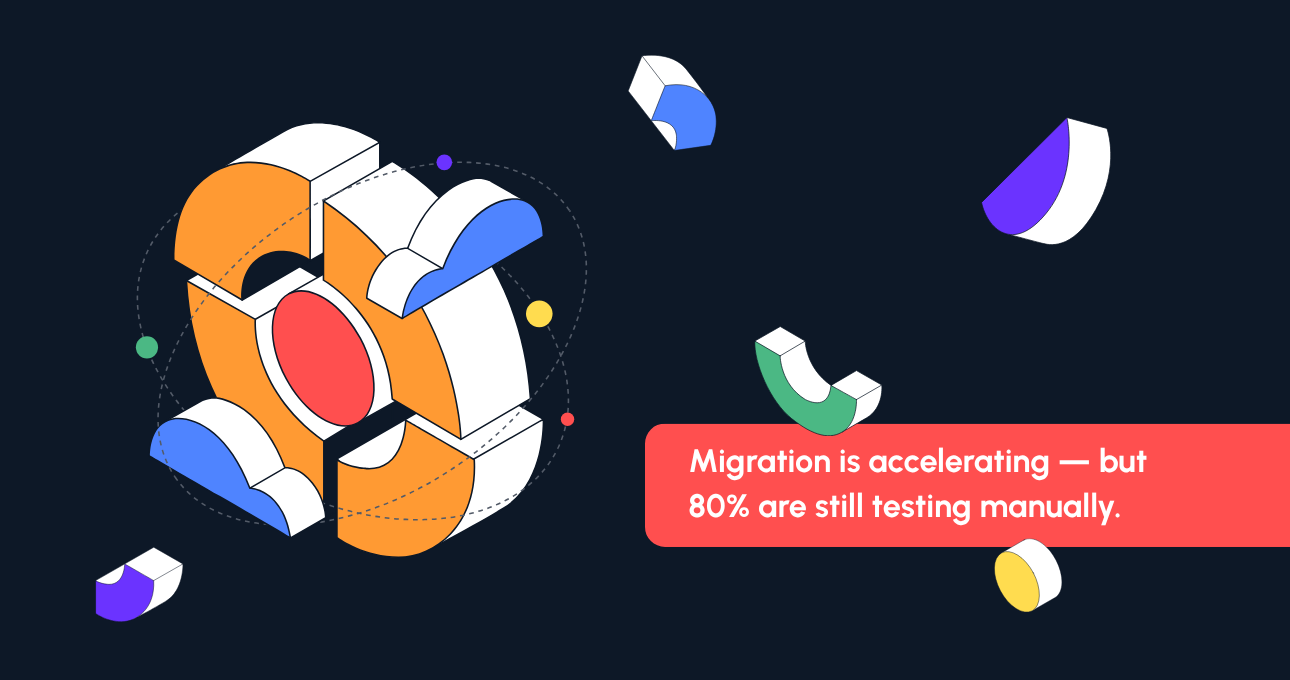
RPI Consultants’ third annual survey of the Infor ecosystem reveals a community accelerating into the cloud – but leaving its testing practices dangerously behind. Here’s what the data shows.
Every year, RPI Consultants surveys the Infor user community to take the pulse of how organisations are managing their ERP investments. The 2026 edition – the third in the series, conducted in December 2025 – is arguably the most revealing yet.
The headline story is one of acceleration: cloud migrations are picking up speed, AI adoption has more than doubled, and demand for training has surged to record levels. But underneath the momentum lies a persistent and largely unaddressed vulnerability – the way organisations test their ERP systems simply hasn’t kept pace with everything else.
Below, we break down the five key findings and what they mean for any team managing an Infor environment in 2026.
1. Cloud Migration Has Hit a Second Wave – and It’s Moving Fast
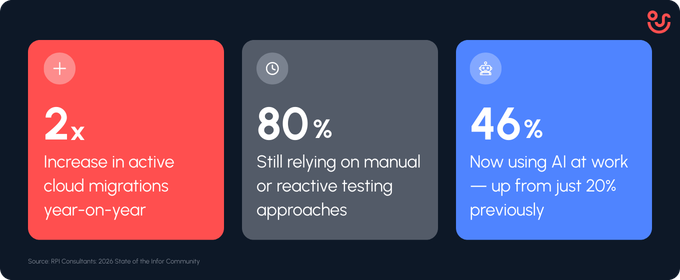
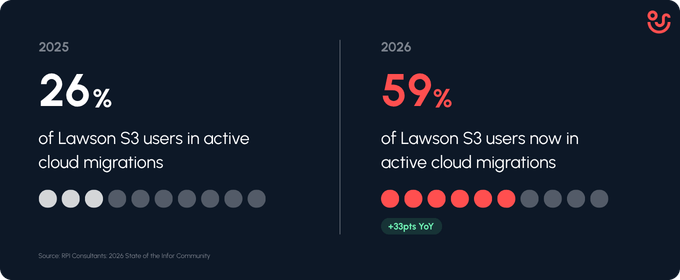
Perhaps the most striking headline from this year’s survey is the sheer pace of cloud adoption. More than twice as many respondents reported being in an active cloud migration compared to 2025, signalling that the Infor community has moved well beyond the early-adopter phase and into a second, broader wave of cloud implementations.
The current tech stack breakdown tells its own story. For finance, 64% of respondents are now on Infor FSM, with Lawson S3 accounting for just 29%. In HCM, the picture is more fragmented – Infor HCM leads at 35%, followed by Infor GHR at 24%, Lawson S3 at 20%, and ADP at 11%. Payroll remains the outlier: 54% still on Lawson S3, confirming the long-held observation that payroll is always the last system to move.
Cloud migrations at this scale aren’t a flip-the-switch event. Projects regularly span 18 months or more – and with Lawson’s 2030 end-of-life date now firmly in view, organisations that delay risk running out of runway.
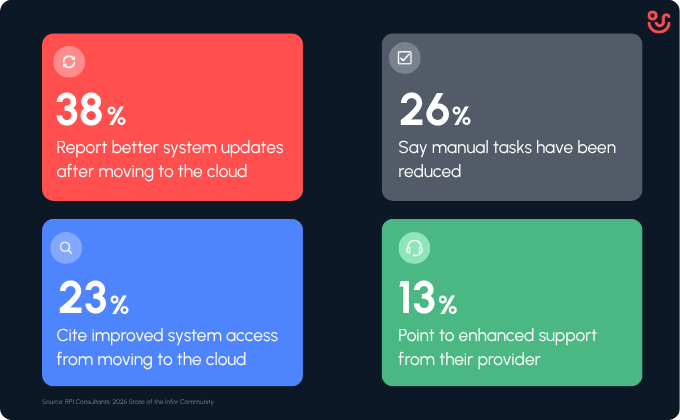
Of those already in the cloud, the quality-of-life improvements are notable: 38% report better system updates, 26% say manual tasks have been reduced, 23% cite improved system access, and 13% point to enhanced support. The case for migration is clearly landing – the question is whether organisations are preparing their testing and change management infrastructure to handle the pace.
2. Testing Remains Predominantly Manual and Reactive
This is where the data becomes most concerning for anyone managing an Infor environment at scale. Despite the frequency of bi-annual Cumulative Updates (CUs) and the growing complexity of cloud-based ERP, the vast majority of organisations are still approaching testing reactively.
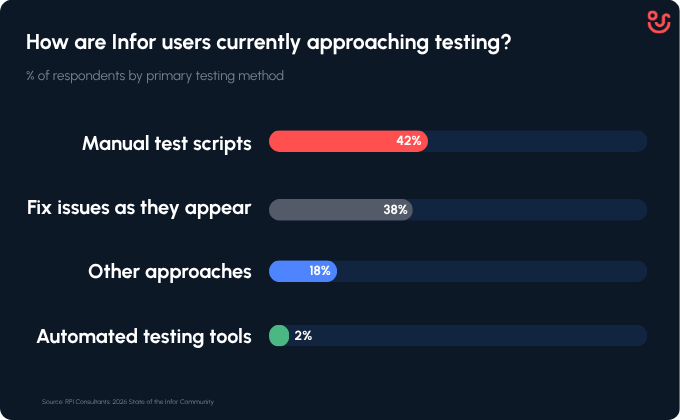
Combined, 80% of respondents are either running time-consuming manual scripts or simply waiting for problems to surface after an update has gone live. Just 2% report using dedicated automated testing tools.
In a world of infrequent releases, this was manageable. In a cloud ERP world where updates arrive twice a year – each carrying new functionality, configuration changes, and potential regressions – it is a genuine operational risk. Post-update disruption, delayed adoption of new features, and real-time firefighting by IT teams are the predictable consequences.
The gap between the pace of cloud releases and the maturity of testing practices is the defining risk factor for Infor organisations in 2026.
The shift to the cloud was supposed to reduce friction. For many organisations, reactive testing is reintroducing it through the back door. Structured, repeatable test automation – with clear ownership and pre-built coverage for core ERP processes – is no longer a nice-to-have. It is a prerequisite for managing the cadence that cloud ERP demands.
3. AI Adoption Has Crossed a Threshold
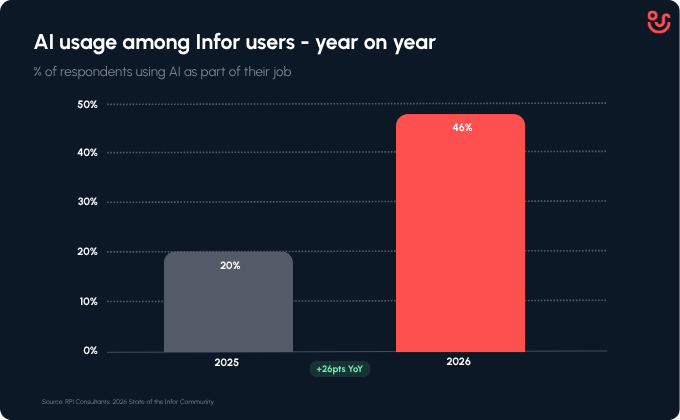
One of the more dramatic year-over-year shifts in this survey is in AI usage. In 2025, 20% of respondents said they were using AI as part of their job. In 2026, that figure is 46% – more than double in a single year.
When asked how they expect AI to change ERP usage going forward, respondents prioritised data analysis and insight generation (68%), automating complex workflows (48%), streamlining decision-making (30%), and reducing manual tasks (16%).
This is AI moving from experimentation into embedded, daily practice. For ERP teams, that has direct implications for how processes are documented, how change is managed, and critically, how new AI-driven functionality is tested before it reaches production environments.
4. Reporting Satisfaction Follows Flexibility, Not Consolidation
The reporting data in this year’s survey challenges a long-held instinct in ERP strategy: the desire to standardise on a single reporting tool. According to the survey, 81% of respondents use more than one reporting tool to meet their business needs – and crucially, organisations using multiple tools report higher satisfaction with reporting overall.
The most widely used tools across the community are Power BI (55%), Birst (48%), GL Report Designer (30%), insightsoftware/Spreadsheet Server (16%), and App Studio (16%), with Tableau, Qlik, and Dashboard Gear also in regular use.
The evidence from the Infor community is clear: reporting satisfaction comes from fitting the right tool to the right use case, not from forcing every need through a single platform.
This has testing implications too. Multi-tool reporting environments mean more integration points, more dependencies, and more surface area to validate whenever an update goes live.
5. The Training Gap Is Growing – and Organisations Know It
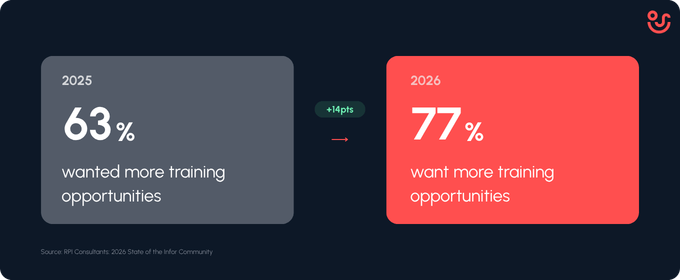
Demand for training has reached its highest recorded level in the survey’s three-year history. 77% of respondents said they would like to see more training opportunities – up from 63% in 2025. That is a 14-percentage-point jump in a single year.
When asked about preferred formats, virtual events (48%) lead the way, followed by in-person events (30%) and networking events (27%). The appetite for hands-on, practical learning is clear.
This gap is a direct consequence of the pace of change. Cloud ERP evolves continuously, and each bi-annual update can introduce new workflows, new interfaces, and new capabilities that users have had no prior exposure to. Without structured training and change enablement, user adoption lags – undermining the return on investment that cloud migration was meant to deliver.
It is also worth noting that well-designed test automation can serve a dual purpose here. Pre-production testing environments give users a structured way to explore new functionality before it goes live – turning the testing process itself into a training opportunity.
The Bottom Line for 2026
The 2026 State of the Infor Community Survey captures an ecosystem in genuine transition. Cloud migrations are accelerating beyond the tipping point. AI has moved from curiosity to regular practice. The hunger for training reflects how quickly the ground is shifting beneath users’ feet.
But the testing data is a clear outlier. While almost every other metric in the survey points to organisations investing in their future, the testing picture shows a community still largely relying on the manual, reactive approaches of an on-premises era. In a cloud world governed by twice-yearly releases, that mismatch carries real risk.
The organisations that will navigate this transition most successfully are those that treat testing not as an afterthought to each update cycle, but as a continuous, structured, and largely automated discipline – one that keeps pace with the cloud itself.
Source: RPI Consultants, State of the Infor Community Survey 2026 (conducted December 2025). Survey conducted across the Infor ERP ecosystem; respondents primarily from healthcare (49%) and IT/finance functions.